Overview of the EAM Framework
Guangyu Zhu
Source:vignettes/00-framework-overview.Rmd
00-framework-overview.RmdWelcome to the tutorials for the eam package!
In these tutorials, you will learn how to customize your own evidence accumulation models and estimate model parameters from observed data.
Evidence accumulation models (EAMs) are major approaches for modeling responses and reaction times in cognitive tasks. The eam package provide a simulation-based framework for simulating and fitting EAMs for single- and multiple-response tasks.
The eam package consists of two parts:
a modular simulation engine that allows users to flexibly customize models and simulate data;
a simulation-based inference module for reliable parameter inference without requiring a tractable likelihood.
In this section, we introduce the two components in detail and demonstrate how they can be combined to build, simulate, and fit customized evidence accumulation models.
Modular simulation engine
The modular simulation engine is built upon the generalized evidence accumulation framework, within which we assume that decision making is characterized as a stochastic process in which evidence is continuously collected over time. The accumulation unfolds in infinitesimal increments , which can be approximated in practice with very small time steps (for example, 1ms}). The moment-to-moment change in accumulated evidence can be expressed as a stochastic differential:
where is the drift rate, is a time step, is the noise scaling parameter, and is a diffusion noise term.
As the process unfolds, the accumulated evidence continues to evolve until it reaches the decision boundaries, at which point a response is triggered and the corresponding RT is recorded. The distance to reaching the boundary is jointly determined by two parameters: the decision boundary () and the starting point ().
As evidence accumulates, the process continues until first reaches either the upper boundary or falls below the lower boundary 0 (in two-boundary EAMs). The elapsed time from the start of accumulation to this boundary crossing defines the decision time; adding a non-decision time yields the observable RT.
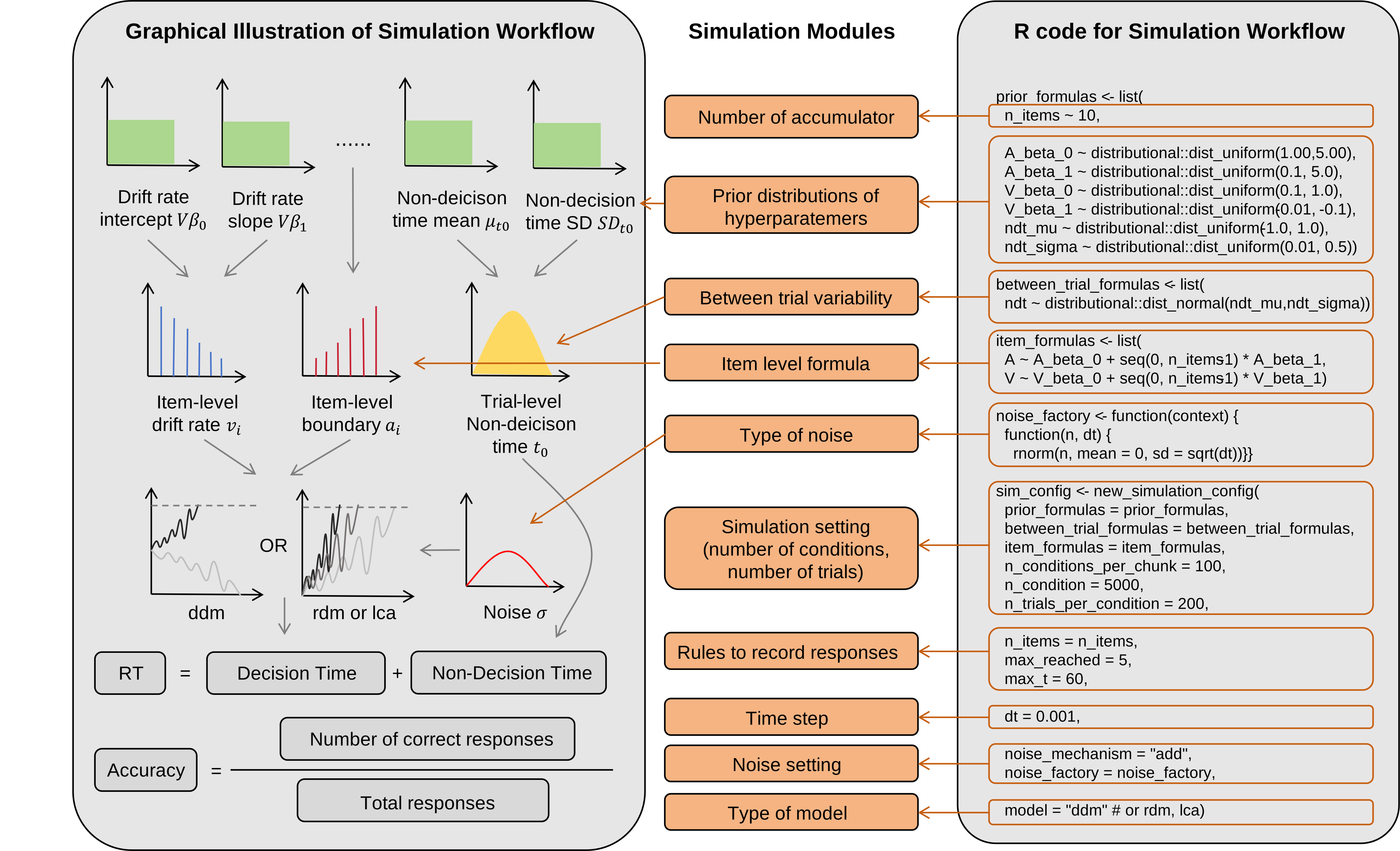
The modular simulation engine allows researchers to flexibly simulate different types of data by changing the evidence accumulation algorithm, the number of accumulators involved in the process, and the decision termination rules. The engine is composed of ten modules (see figure below):
Number of accumulators: the number of accumulators that race or compete toward a decision boundary (e.g., one in DDM or LFM; multiple in LBA, LCA, or RDM)
Prior distribution of hyperparameters: hierarchical priors specifying mean, variance, and regression coefficients for core parameters of the evidence-accumulation process including drift rate, decision boundary, starting point/relative bias, non-decision time, leakage parameter, strength of lateral inhibition, and stability parameter.
Between-trial variability: specify the formulas for between-subject or between-trial variability in parameters, also allowing linking covariates to the subject- or trial-level parameters.
Item-level formula: linking each accumulator’s parameter to item indexes or output positions to generate the accumulator-level parameter values such as drift rate or decision boundary, also allowing linking covariates to the item-level parameters.
Type of noise: family of diffusion noise (e.g., Gaussian vs. Lévy -stable vs. deterministic ballistic).
Simulation setting: the configuration used for model simulation, including model equations, number of conditions, number of trials per condition, and other implementation parameters.
Rules to record responses: the criteria determining when and how responses are recorded (e.g., first boundary crossing only, or the first releases within a time limit).
Time step: the discrete increment used to approximate continuous-time evidence accumulation (default at 1,).
Noise setting: the algorithmic specification of stochastic increments (e.g., additive vs. multiplicative).
Type of model: the underlying architecture of evidence accumulation (e.g., single-boundary vs. double-boundary vs. LCA accumulators).
By combining different modular components, the engine can simulate responses and RTs from many representative EAMs (see the section Models in eam for the configurations of each representative EAM).
Once the data are simulated, they can be directly passed to the inference module for parameter estimation.
Simulation-based inference module
The simulation-based inference module includes two major apporaches: Approximate Bayesian Computation (ABC; Csilléry et al., 2012) and Amortized Bayesian Inference (ABI; Sainsbury-Dale et al., 2024). These methods can estimate the posteiror distribution of parameters via the comparsion between simulated and observed data, bypassing the need for likelihood functions.
Approximate Bayesian Computation (ABC)
The Approximate Bayesian Computation (ABC) approximates the posterior distribution by comparing summary statistics from simulated data and observed data :
where denotes a vector of summary statistics, is a distance function, and is a kernel with tolerance .
Here, the intractable likelihood is replaced by a kernel-weighted similarity between summary statistics of simulated and observed data, such that parameters producing simulations closer to the observed data receive higher posterior weight, with the tolerance controlling the approximation accuracy.
In the classical Rejection ABC algorithm, for each iteration : (1) draw ; (2) simulate ; (3) compute ; (4) accept if .
This produces the approximate posterior .
However, the Rejection ABC algorithm suffers from low acceptance rates and a bias–variance trade-off in the tolerance . To address this, Beaumont et al. (2002) proposed a local linear regression adjustment: which is then adjusted toward : This adjustment allows simulated samples that would otherwise fall outside the tolerance to be shifted into the acceptance region, which increases the acceptance rate and reduces sensitivity to the choice of .
Following this direction, Ridge regression adjustment extends it by projecting summary statistics into a high-dimensional RKHS using kernels (e.g., Gaussian RBF), enabling nonlinear estimation of . Blum et al. (2010) proposed a nonlinear, heteroscedastic regression model: with and estimated using neural networks with weight decay on accepted pairs. This correction improves robustness in high-dimensional summary spaces and mitigates the curse of dimensionality.
Amortized Bayesian Inference (ABI)
While methods such as ABC require running inference each time new ABI allows one to first train a neural network that learns a mapping between the parameter space and the data (or summary statistics), and then reuse this learned mapping to directly infer parameters in subsequent analyses without repeated optimization.
Existing implementations of amortized Bayesian inference (ABI) in this package are neural Bayes estimators and neural posterior inference.
Neural Bayes estimators aim to find decision rules that minimize the Bayes risk under a chosen loss and prior : where is the latent true parameter and is the estimator produced from data (or summary statistics) . The loss function may be chosen flexibly (e.g., quadratic, absolute, quantile loss), leading to different Bayesian optimal decision rules (e.g., posterior mean, median, quantiles). By optimizing the loss function via backpropagation and stochastic gradient descent using simulated pairs, neural Bayes estimators amortize the cost of inference. Once trained, the network can be applied repeatedly to new observed data to produce fast and accurate point estimates with essentially zero additional inference cost.
Neural posterior estimators, on the other hand, aim to approximate the entire posterior distribution by learning a mapping from data to the parameters of a chosen distribution family through minimization of the expected Kullback–Leibler divergence between the true posterior and the approximating distribution: where is the trained neural estimator, is the approximated posterior family, and the expectation is taken over all possible realizations of .
A standard workflow in the eam package
A standard procedure of simulation-based inference involves several steps:
First, a generative model or simulator is defined, which specifies how observable data are generated from underlying parameters .
Second, parameters are sampled from a prior distribution , reflecting prior beliefs or theoretical constraints.
Third, for each sampled parameter value, synthetic datasets are simulated from the model, producing pairs of parameters and corresponding simulated observations.
Fourth, the similarity between simulated and observed data is quantified—either by computing distance metrics between summary statistics, as in Approximate Bayesian Computation (ABC) or Amortized Bayesian Inference (ABI).
Finally, the approximate posterior distribution is obtained by weighting or sampling parameters according to this similarity or likelihood estimate.
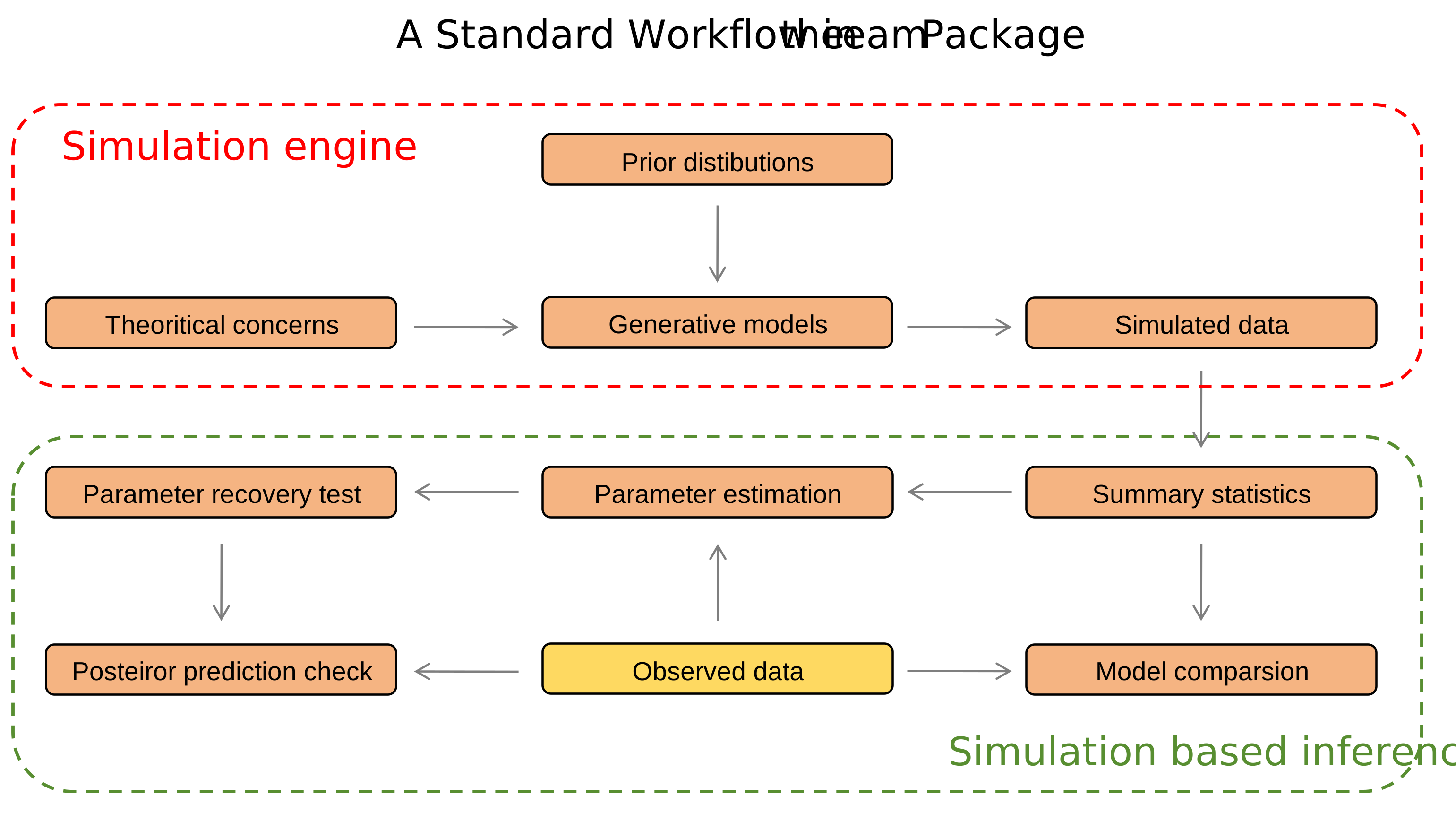
The following sections provide a structured overview of the standard simulation and inference workflow supported by the package.
Section 1: Getting Started: A Minimal Working Example introduces the core functions of the package and provides a minimal runnable example based on a three-parameter Drift Diffusion Model (DDM).
Section 2: Models in eam demonstrates how representative evidence accumulation models can be specified within the package, and how they can be extended to multi-response settings or intergeted with covariates.
Section 3: An Empirical Example: Simulation-Based Inference for Free Recall presents a real-world application using free recall data, illustrating how the package can be applied to empirical datasets in practice.
Reference:
Beaumont, M. A., Zhang, W., & Balding, D. J. (2002). Approximate Bayesian computation in population genetics. Genetics, 162 (4), 2025–2035. https://doi.org/10.1093/genetics/162.4.2025
Blum, M. G. B., & François, O. (2010). Non-linear regression models for approximate Bayesian computation. Statistics and Computing, 20 (1), 63–73. https://doi.org/10.1007/s11222-009-9116-0
Csilléry, K., François, O., & Blum, M. G. B. (2012). abc: An R package for approximate Bayesian computation (ABC). Methods in Ecology and Evolution, 3 (3), 475–479. https://doi.org/10.1111/j.2041-210x.2011.00179.x
Sainsbury-Dale, M., Zammit-Mangion, A., & Huser, R. (2024). Likelihood-free parameter estimation with neural Bayes estimators. The American Statistician, 78 (1), 1–14. https://doi.org/10.1080/00031305.2023.2275927